Our response to the A38 cycle lane extension
We enthusiastically welcome the plans while identifying specific design issues.
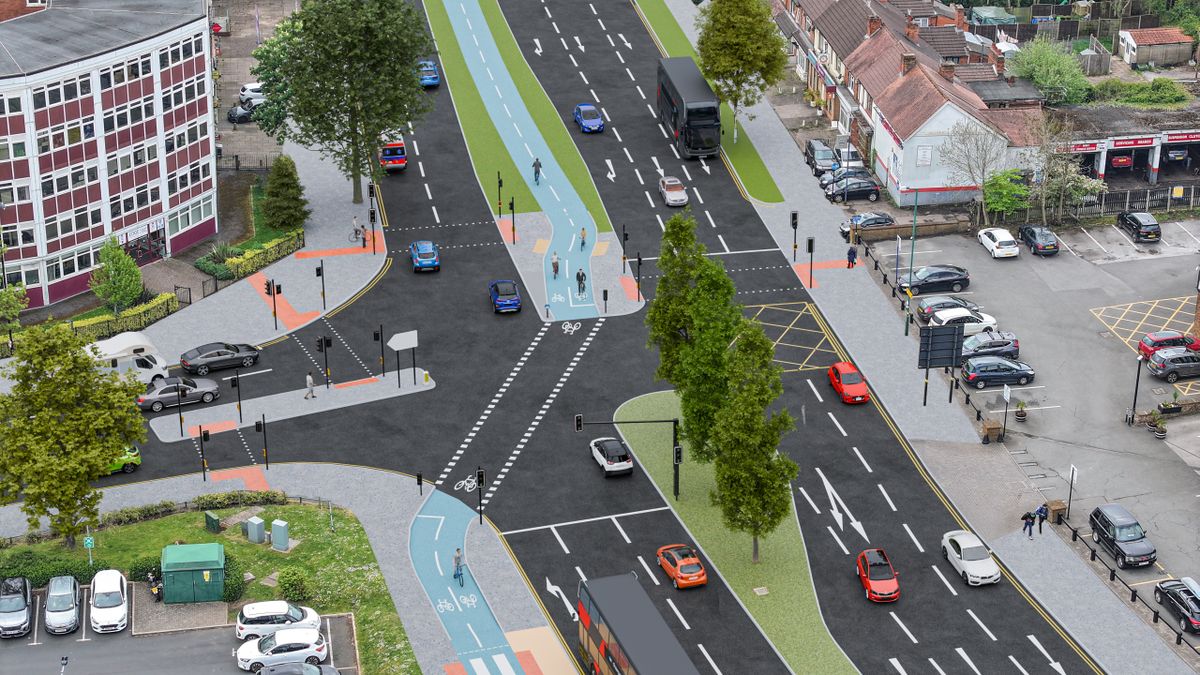
This is Better Streets for Birmingham's response to the A38 cycle lane extension consultation from Selly Oak to Northfield and Longbridge. The consultation is open until 28 July 2025. If you agree with the response, please write a response on the consultation page and link to this page.
The Bristol Road (A38) corridor
The current provision
The current provision of the A38 cycle lane between Selly Oak and Longbridge is insufficient and unsafe. There are sections of advisory and mandatory in-carriageway cycle lanes - nicknamed ‘murder strips’ - which forces cyclists to go around stopped buses, and being in the carriageway puts cyclists at high risk from close passes and prolific speeding. The drainage is insufficient and wet weather often turns the side of the carriageway into a river, sometimes flooding the entire road.
Other stretches of the current provision are shared use paths that have not been designed to accommodate any volume of cyclists. They involve crossing dangerous side roads, sometimes without even basic facilities such as a dropped kerb.
The opportunity
The corridor benefits from being linked to the Rea Valley Route, River Rea Trail, Merritts Brook Greenway, and other existing piecemeal provision through the wider area. Completing this project will provide a safer route along the A38 for those who want to wheel or cycle. Cycle use on the River Rea Route, the River Rea Trail and Merritts Brook Greenway show that there is demand in the area and that this new provision will be well used.
This is alongside repeated studies that show Birmingham’s residents and children are open to cycling more with higher quality and safe provision.
The corridor has many primary schools, secondary schools, sixth forms and colleges. Children already cycle and scoot to school using the pavement as the current provision is unsafe. Again, case studies show that the better the cycle route provision to a school, the more children will cycle to school. As the school run is a significant driver of congestion, measures to address this should be a priority.
The new provision will also link residents to major employment centres in Longbridge and Selly Oak, including hospitals where public transport needs much improvement especially for late finishing and early starting staff. There are also community facilities like high streets, leisure centres and parks along the route.
This route is as much about small trips around local areas as enabling a Longbridge to City Centre continuous cycle lane.
Engagement to date
We have been extremely pleased with engagement with stakeholders on this scheme to date and note changes to the design in response to feedback from stakeholder workshops. We are particularly pleased with the additional toucan crossing between Manor Farm Park and Royal Orthopaedic Hospital, which makes the current informal crossing safe. This is an example of what good looks like.
Overview
Much of the design for the A38 cycleway extension is to be commended.
Reducing the number of points vehicles can cross the cycleway is a great move. Increasing the number of Toucan crossings throughout the corridor to safely reconnect communities, as well as safely getting people to and from their nearest bus stop, is a welcome improvement.
We particularly welcome addressing some entirely unsafe turning junctions such as South Road, Bournville Lane and Lodge Hill Road.
However, the scheme suffers from the same issue that the current section does: it relies on unintuitive shared paths to access the cycleway, rather than safe spurs from within communities. A cycle network only works when it truly is a network. And while it is great that there is a reduction in the number of central reservation crossing points for vehicles, we feel the reduction could be even higher.
The gap in the cycleway provision in Northfield - to ’tie into existing shared use facilities’ - is deeply disappointing. A cycle lane is only as good as its weakest point, so having a gap in the proposed design is a serious flaw that needs addressing.
As with all schemes, we request a comprehensive signage approach, especially given users will be in the central reservation and need to know in advance which toucan crossing to use when leaving. Signage can be attached to cycleway lighting columns to reduce clutter. Signage should include the minutes travel time to a range of destinations with safe cycle provision. We would like to be involved in the signage placement process.
We also support the consultation response submitted by Pushbikes - Birmingham’s Cycling Campaign.
Issues
Central reservation crossings
It is with serious luck that there has yet to be a serious collision at the Eastern Road junction on the existing A38 cycleway. So, while it is fantastic that some central reservation gaps are being closed, we remain concerned that adding more junctions following the same design as the existing cycleway will massively increase the chances of that happening.
It also feels like a design decision that only works with low levels of usage of the cycleway, which as the scheme beds in, could increase the chance of conflict despite the right of way at rush hour.
Similarly, enforcing road classifications through neighbourhood major schemes to predetermine through-traffic flow and reduce shortcutting, would enable the removal of further central reservation crossings. Cob Lane, Griffin Brook Lane, Hole Lane and St Laurence Road could all benefit from a through-traffic reduction approach, and we feel this highlights tensions with the Birmingham Transport Plan approach to addressing corridors and neighbourhoods separately.
Even if the crossings are kept, we believe a good candidate for filtering in this scheme would be the Griffin Brook Lane junction, given the proximity to Cob Lane. We would also ask that the scheme designers consider what treatments can be made to junctions so that people driving have no option but to stop and look around before continuing over the cycle track.
Lodge Hill Road
We would like to see this road receive a modal filter as it has a primary school situated on it. This would improve the safety of school children, as well as providing a low-traffic cycling route towards Weoley Castle.
Weoley Park Road
Restricting right turns into the road with a bus gate is a good move. We would like to see the junction turned into a left-turn only to remove a point of conflict with the cycle route, with traffic turning right using the proposed re-engineered junction with Middle Park Road instead.
Uphill section to Weoley Park Road
We are concerned that the width of the cycleway has not been increased on this uphill section, making it difficult for cyclists to overtake going up the hill. We would prefer the cycleway to be increased in width instead of laybys as further south in the scheme.
Witherford Way
Again, given the changes to Middle Park Road and Bournville Lane, we would advocate for a modal filter to be installed at the turning into Witherford Way. Residents can easily use Fox Hill and Weoley Park Road or Middle Park Road instead for all traffic movements. This would also remove the requirement for the two central reservation gaps.
Middle Park Road and Bournville Lane
This junction is a vast improvement of the layout as they stand today. However, as this junction becomes easier to navigate, without addressing shortcutting traffic through Weoley Castle, this risks increasing the unofficial corridor as a shortcut from Barnes Hill or California and Bournville Lane.
One use for the new capacity could be to reduce the need for central reservation crossings as we have already discussed. Alternatively, we would suggest that Middle Park Road be considered for a through-traffic reduction scheme, reducing the capacity requirements for this junction, potentially allowing for a smaller, and cheaper, design.
Northfield High Street
We understand that when this scheme was originally put forward for funding, there were submissions to the government for changes to Northfield local centre. However, given that the funding fell through, the 500-metre gap in the cycleway around Northfield High Street is unfortunate and creates two cycle tracks: Longbridge to Northfield and Northfield to the City Centre.
A cycle route is only as good as its weakest point, so asking people to use either a path shared with pedestrians (which we do not consider to be good cycling infrastructure) and involves navigating the Sir Isaac Tongue junction, or the High Street itself, seem like retrograde steps.
We have seen the impact of this play out with the A45 corridor where there is a low quality link between Bradford Street and Bolton Road, which has significantly impacted overall usage. The Council should look to infill the gap (as well as the example given on the A45) as soon as possible.
Alternatives
Given the current proposals are unacceptable, we propose three options from “do minimum” to “do maximum”:
- Do minimum:
- Ensure that cyclists can join and leave the cycleway into the high street’s carriageway on either end where cycle lane provision ends
- Paint cycles on the carriageway along the high street
- Upgrade the pedestrian crossing on the high street side of the Sir Isaac Tongue junction
- Upgrade the two side roads (car park and Lockwood Road) so that pedestrians and cyclists have priority
- Do maximum (minimum, plus…):
- Extend the separated cycle track around the bypass, or
- Install bus gates strategically to remove through-traffic from using Bell Lane for Sir Isaac Tongue Junction
Illustrations of 'do minimum' controlled junction changes
Lidl planning application
There is a planning application for Lidl (2023/07943/PA) currently being appealed that proposes a turn-right lane on the northbound carriageway to turn into a car park. That junction would go through the planned positioning of the cycle track.
Despite us pointing this out to the design team and Birmingham City Council Planning, it was mentioned neither in the planning officer’s report nor the highways response to the application. This needs to be watched carefully in case both accidentally get approved.
Hill Top Road
Hill Top Road is a prolific shortcut and suffers with speeding issues. Its proximity to Frankley Beeches Road and the Black Horse junction is a good case for filtering Hill Top Road. This would remove the need for another central reservation gap crossing.
Overtaking lanes near to junction with South Road
We appreciate the design team has responded to our feedback about overtaking lanes, but we would appreciate either making the cycleway wider for longer, or just not having them. It’s hard to see how they can be used to overtake without someone completely stopping which appears unproductive on an incline.
Tessall Lane
In making the following suggestions, we are doing so without any knowledge of the planned signal phasing, and assume that the phasing is able to be changed.
Having the traffic lights at this junction be green in a single direction at a time could allow traffic from The Roundabout and Farren Road to perform u-turns at the lights.
Single direction phasing could potentially remove the need for a right-turn lane on the southbound carriageway.
Longbridge Lane
We would like to see the cycleway continue all the way to Longbridge Lane, as well as a future extension to Longbridge Station and the town centre. There are plans for thousands of houses nearby, so this could be sought as a contribution from that development.
Currently, it would be more direct for cycleway users to use the permissive path to Devon Way which has a low amount of traffic, to reach the station, town centre, or the trail to Rubery Lane.
We understand that Sustrans are interested in designating this route as National Cycle Network Route 5 with the Rea Valley Route being designated another number. For the purposes of navigating NCN Route 5, it seems an omission to not to link the cycleway to West Works Way’s bidirectional cycleway, which also connects to the River Rea Trail.
We encourage the Council to seek this as a section 278 improvement (along with improving integration of the River Rea Trail with Rubery Lane) as part of the 2025/02262/PA planning application, which is currently progressing through Planning for the remaining industrial units at West Works, Longbridge.
Outstanding snags to the existing cycle lane
In the spirit of a cycle lane only being as good as its weakest point, we have identified quick win, zero-cost changes to signal timings for the existing cycle lane, that we would like to be investigated by BCC’s Highways team as part of a route-level review:
- An apparent defect with the crossing outside University Gates which halts the cycle lane despite general traffic being on green
- Revisiting whether the crossing at the junction with Edgbaston Park Road should allow for one full cycle crossing phase instead of two stages
- Investigating why the ballet school crossing continues to become defective
- Evaluating whether the Belgrave Interchange cycle phase is maximising cycle crossing time
- Adjusting all cycle crossing sensors on the route as some appear to be obstructed or facing in a strange position for cycle traffic
There are also maintenance defects with:
- Selly Oak Triangle (close to crossing next to KFC) where there is a pothole and loose tactile paving
- Tree roots along the main carriageway
- Patch works where utility companies have not come back to repair with materials, throughout the cycleway
Conclusion
We enthusiastically support the progress and scheme. We believe to have identified both cost saving and cost adding issues, which should meet the overall cost envelope.
We look forward to building a safer, greener and greater capacity A38.