Our response to bus franchising proposals
We fully support plans to franchise bus services in the West Midlands along with new bus priority measures to make buses more reliable.
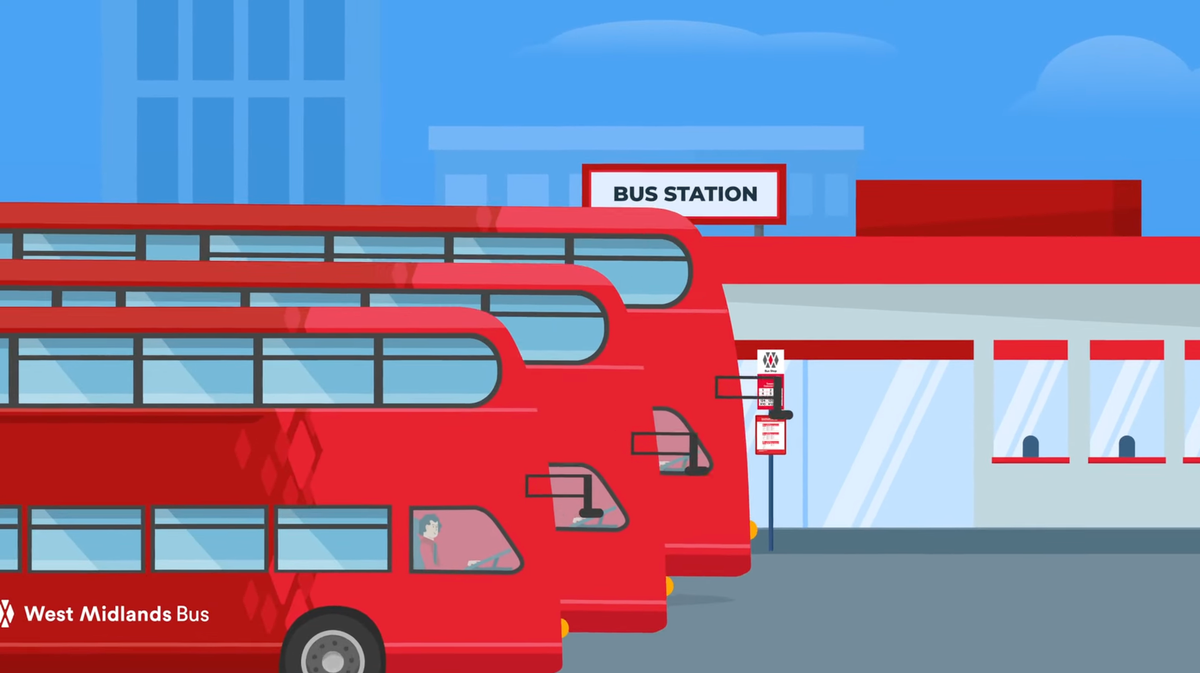
This is our response to proposals to franchising bus services in the West Midlands. If you agree with our response, you can reply to say you agree with Better Streets for Birmingham’s response.
Better Streets for Birmingham is a community organisation that represents people who work, live and play in the city of Birmingham. We campaign for streets where everyone gets home safely and where there are genuine alternatives to driving.
We fully support the proposals to franchise bus services in the West Midlands.
We have offered additional considerations, including the need for bus priority measures, as part of our responses but ultimately see franchising as one of the necessary and urgent steps to improve bus services.
Better buses is a big move towards genuine alternatives to driving, which will reduce the number of cars making trips and lead to safer roads for everyone.
S1. There are several challenges facing the West Midlands Bus Network which means that it is not performing as well as it could. Do you have any comments on this?
The bus network across the region is broken. Passengers are forced to tolerate increasingly unreliable services with constant delays and cancellations, dirty buses, service cuts, and all the while fares climb steadily higher.
Delays and cancellations can often be the result of a lack of prioritisation on the region’s road networks, leaving buses caught in congestion which is especially prevalent in orbital routes, which leads to services becoming an unreliable and therefore unattractive alternative to driving.
Buses in the West Midlands are in a clear and accelerating state of decline. It is apparent that the operators are unable to make a satisfactory profit, and as such are running the entire network slowly but surely into the ground.
The trajectory is clear, and radical action is required to preserve what is a valuable service to many residents, and a critical lifeline to some. The buses are the lifeblood of the West Midlands transport system, and are absolutely crucial to many of our most disadvantaged residents, with disproportionate ridership among women, non-white ethnic groups, and both older and younger people.
S2. Reform is considered to be the right thing to do to address the challenges facing the local bus market. To what extent do you agree or disagree with this?
We strongly agree with the need for reform. It is clear the status quo is not working, and the only reasonable course of action is to change the way the system operates. Franchising is one of a limited number of available options, and presents the only real opportunity to save our bus network from continued decline.
S3. Do you have any comments on the approach to procuring, operating, and managing the Proposed Franchising Scheme?
We hope that franchising is a step on the way to fully municipal bus services, as a service run purely in the interest of passengers will always outperform one motivated by profit.
Given the large and growing extent of procured services already, it seems like a sensible decision to franchise all services, allowing for competition between operators, but not on the same routes. This approach seems likely to drive down costs and drive up standards.
Taking ownership of depots and vehicles also presents an opportunity to clean up the fleet, and accelerate the crucial journey to a zero-carbon transport system.
S4. It is suggested that the Proposed Franchising Scheme will offer value for money. Do you have any comments on this?
We strongly agree with this assessment. There will be necessary initial capital expenditure, as would be the case for any business taking on a new service, but this seems highly likely to see a return, as it only needs to reduce the existing growing subsidy delivered to operators.
The retention of fares creates a virtuous cycle in place of a vicious one. Investment in vehicles, and crucially in bus priority measures, will drive up patronage and therefore revenues. The greatest issue facing bus services is congestion due to cars, and currently it is difficult to justify significant bus priority as doing so simply hands greater profits to private operators. We must shift people from private cars to more sustainable transport options, but above all existing bus passengers deserve a decent service.
S5. It has been concluded that the WMCA could afford to introduce and operate the Proposed Franchising Scheme, but this carries additional financial risk. Do you have any comments on this?
We are comfortable that the risk is acceptable and proportionate to the likely benefits of the scheme. The risk associated with the do-nothing case is unacceptable, and so intervention is necessary. The non-financial risk in terms of the social impact of service cuts, and the climate impact of growing car dependency are also unacceptable.
It is worth highlighting the other economic benefits of improved bus services, as they are likely to generate jobs, reduce congestion, and improve air quality (and subsequently health outcomes). The lens of the analysis seems narrow, and presents a worst-case scenario, a broader view of the scheme presents many opportunities which may be capitalised upon.
S6. To what extent do you support or oppose the introduction of the Proposed Franchising Scheme?
We strongly support the introduction of the proposed franchising scheme. It is clear that action must be taken, and franchising is the only serious option available. Any other approach is simply tinkering around the edges of a clearly broken system.
S7. Are there any changes that you think would improve the Proposed Franchising Scheme?
We hope to see the creation of a municipal bus operator who can bid for routes, and who can reinvest every single penny of revenue instead of significant sums being syphoned off by shareholders.
We want a specification where all new buses have zero tailpipe emissions, and that they can have common sense improvements such as multiple doors to reduce dwell time at stops.
All buses should be GPS tracked and available as an online map, where planned and unplanned disruptions are meaningfully communicated along with diversionary routes. The ongoing issues with real-time information, particularly around ghost buses, needs resolving.
On bus vehicles, we want to see audiovisual announcements introduced across all vehicles, along with improvements to information available, for example through showing the route, connecting services for buses, trains and trams.
As well as improvements to vehicles and information, we want to see improvements to infrastructure at stops and stations, such as more shelters (with seating) and bicycle parking to support integrated journeys, and increase the catchment area of our bus services.
In terms of the ticketing available, we want to see a timed fare that enables passengers to travel for 60 minutes with unlimited transfers, we would like to see this approach rolled out across modes, for example the 2-hour single ticket offered in Berlin. It is important that contactless EMV (cEMV) ticketing is available from the point of the first franchised service at the latest.
S8. Do you have any comments on the Health and Equity implications as set out in the Health and Equity Assessment?
I think it is worth noting that there are actually positive impacts on a number of protected characteristics under the Equalities Act. As stated, bus passengers are more likely to be women, non-white, disabled, and older or younger people. Improvements to bus services represent a genuine improvement in equity for those who currently face structural disadvantages in the West Midlands.
We shouldn't be satisfied with interventions that just don't make the existing inequalities explicitly worse, we should be actively prioritising interventions, like this one, that actually counter the prevailing systems.
S9. Do you have any further comments?
Bus franchising finally offers a genuine opportunity to improve bus services. Buses are a neglected form of transport by politicians and policy makers, and it is surprising that they have retained such complete dominance of the public transport system in the region given that fact.
While we seem to have very deep pockets for high-profile schemes such as metro, buses attract precious little funding. Franchising creates a clear and simple business case for all future improvements to bus services, and has the potential to finally move us towards a genuinely attractive public transport offer for people beyond those few who live near to a train or metro line.
A franchised bus service also supports the business case for other schemes which encourage modal shift, such as protected cycleways, as every car trip replaced by a more sustainable option relieves congestion across the network and further improves bus service reliability.
It is important that this investment in the bus network is supplemented with bus priority investment. It has been disappointing that the delivery of some bus priority measures planned in the CRSTS1 period will continue beyond 2027. Further to arterial cross-city routes, bus priority interventions for suburban orbital routes should be prioritised for funding.
We recommend that TfWM resist any temptation to change the West Midlands Bus branding which would incur an unnecessary wider expense. There is already a solid framework for integrated network branding in place in the West Midlands. The missing piece of the puzzle, as ever, is multimodal contactless capping.