Ep.8 - Clean air in Birmingham with Kirsten de Vos and Florence Cadge
Kevin Carmody is in conversation with Kisten de Vos of Mums for Lungs and Florence Cadge of Birmingham Healthy Air Coalition.
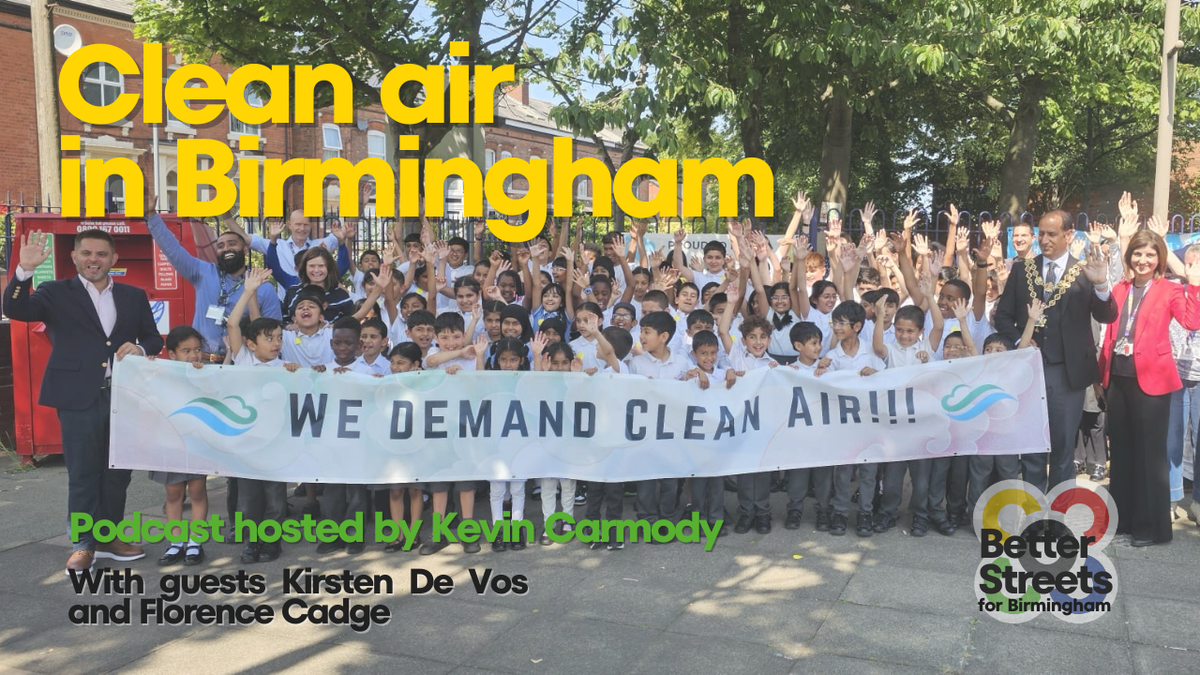
Host Kevin Carmody is in conversation with Kisten de Vos of Mums for Lungs and Florence Cadge of Birmingham Healthy Air Coalition. This conversation explores the legacy of Councillor Waseem Zafar and the ongoing efforts to improve air quality in Birmingham. It highlights the importance of collaborative initiatives, the impact of the Clean Air Zone, and the challenges that remain. The discussion emphasises the need for community engagement, awareness of air pollution's health impacts, and the social justice issues surrounding environmental health. The speakers advocate for individual actions and policy changes to create a healthier environment for future generations.
https://brumhealthyair.org.uk/
Also available on Apple, Spotify, Deezer and other podcast players.
Transcript
Kevin Carmody (00:05)
Welcome to Better Streets of Birmingham. Today we're going to talk about clean air and why it matters to anyone who wants a safer, healthier streets for walking, cycling and wheeling. Birmingham recently lost Councillor Waseem Zafar at the age of 44. He was a champion of clean air within the city, particularly the clean air zone, and he understood that every time someone walks or cycles instead of driving, our air gets cleaner.
Today I'm joined by two people. I'm joined by Kirsten De Vos of Mums for Lungs and Florence Cadge Welcome to you both.
I'm probably going to come to you first Florence. So could you tell us a little bit about Waseem himself, who is what he achieved within the city,
Florence (00:53)
of course. He was ⁓ the councillor who introduced the Clean Air Zone in the centre of Birmingham, which we've seen to have a massive positive effect on people's health and on levels of air pollution for the city. It's also supported.
numerous clean air related projects around the city as well. So that's been a great success. He was very, very active in his local community of Lozells where he grew up and where he was raising his family. You know, he was the governor of the school that he went to and that his a few of his boys attended and still do attend.
He was on the board for The Active Wellbeing Society, which is a community benefit society that I work for. He was governor and chair of many organisations, really, you know, offering his time and energy and expertise in lots of different spaces. Yeah, he was, you know, I worked with him very closely.
certainly a friend as well as a colleague ⁓ and yeah he had a great influence on the city.
Kevin Carmody (02:11)
And he founded the Birmingham Healthy Air Coalition, which is part of the Clean Air Justice Network. I mean, that's an important thing, isn't it? Kind of bringing groups together.
Florence (02:22)
Yeah, absolutely. He founded the Clean Air Justice Network, which was more of a of light touch and formal network in the first instance, but that paved the way for the Birmingham Healthy Air Coalition.
⁓ And yet currently the Birmingham Health and the Air Coalition has over 30 partners of which Better Streets of Birmingham is one of them. And those are all groups who have a focus on improving the air quality in Birmingham, reducing toxic air. So we collectively work together to come up with policy asks and create events which increase awareness around.
⁓ the issue of air pollution and how people can be best informed and better protect themselves and their children.
Kevin Carmody (03:11)
And Kirsten, so you're with Mums for Lungs and Mums for Lungs is part of the Birmingham Healthy Air Coalition. You've done quite a lot of events with them as well, haven't you? mean, how important is it, ensuring we work collaboratively?
Kirsten (03:27)
Yeah, thank you. Yeah, I remember joining Waseem's Clean Air Justice Network. I think, I feel like it must be nearly four years ago now. And he was always incredibly supportive of why I worked with Mums and Lungs. I'm really, really grateful to him. And subsequently, Birmingham Healthier Coalition. I think it's just, yeah, having a joined up approach.
⁓ and many voices saying the same thing is very important ⁓ across Birmingham and across the country.
Kevin Carmody (04:02)
I think as you touched on earlier on there, Florence, probably his biggest impact for most residents in Birmingham is the clean air zone, which has in many ways it's been a huge success as far as ⁓ improving air quality in the city.
Florence (04:18)
believe that it was introduced because we as a city were heading towards non-compliance with EU legislation. So there needed to be an intervention brought into place. There were a number of interventions that have happened in other places in Europe ⁓ and we've seen and colleagues in City Council.
chose to go ahead with this type of clean air zone. And there's different levels to clean air zones. I believe this is a three. ⁓
Kevin Carmody (04:46)
Right.
Yeah, OK. Yeah, I mean it is it has it has been very, as I say, kind of very effective.
intervention ⁓ in so far as ⁓ reduction of 40 to 50 percent of nitrous oxide levels within the city. This is mostly though with people moving to increasingly compliant cars rather than necessarily reduction in car numbers, which I know has created a fund which has made it available for other measures to be ⁓ placed within the city.
giving councillors small kind of pots of money to be able to make improvements within their local area.
Kirsten, have you, ⁓ as an organisation, tracking the impact of the clean air zone across communities in the city?
Kirsten (05:40)
Well, as an organisation, we're huge supporters of clean air zones. We think they're a really important intervention. So we were very supportive of Birmingham's clean air zone. ⁓ And it's been proven to bring down nitrogen dioxide levels in the city centre. ⁓ And, you know, the number of non-compliant cars has dropped as well.
I think that there are some exceedances is my understanding. think around Wall Street, Queensway, I think from really all around Snow Hill Station. So they need to be addressed, cleaner buses, cleaner public transport. We need to do something honestly about our trains as well. And I was always a little bit concerned as well about what was happening on the perimeter. For example, I'm thinking of Percy Shermer School. So I…
I'm very much very supportive of it, but I think it could go further. know there's potentially plans to be disbanding it as we meet the air pollution targets. So that's a huge question, isn't it? What happens moving forward?
Kevin Carmody (06:43)
Yeah, mean that's something like 61 million a year I think is what is a fund that the council gets available because of the Clean Air Zone. We're coming up to that inflection point now aren't we where we're going to have to decide what to do with the Clean Air Zone.
Florence (07:03)
Yeah, I mean, I'm of the opinion that it needs to, you know, stay in situ ⁓ and would echo Kirsten that, you know, there are other improvements on kind of individual ⁓ basis that need to happen within the clean air zone also. ⁓ So, you know, the electrification of transport is a huge one. ⁓ We've seen some real progress with that in Birmingham in terms of ⁓ buses.
and the mayor and his team have done a brilliant job of that. ⁓ However, there are a number of diesel trains that still run throughout the city. ⁓ When you're ⁓ at New Street, especially on a platform, can't often taste and smell air pollution. But when I spend some time on a New Street platform, sometimes it's quite overwhelming. ⁓ And I can't help but worry about how that affects.
my health personally, but also, you know, everybody else traveling, ⁓ as well as the colleagues who work on the station, on the platforms, ⁓ on the kind of concourse above.
Kevin Carmody (08:12)
Absolutely,
you mentioned there Kirsten about the Moor Street we are seeing ⁓ development plans being put into place in order to cut down traffic around Moor Street now
Kirsten (08:24)
I get the bus regularly there and I'm getting more, you know, electric buses. Certainly, I think they have to be compliant that they're going to the centre. It certainly feels to me like it's getting better, but like Florence says, can still, you can taste it in certain areas of the city centre, definitely.
Florence (08:39)
Yeah, it's interesting. outside Moor Street, where you've got the hill that goes up alongside Moor Street, the area at the bottom of that hill tends to exceed any recommended levels of air pollution really, really often just because of how
Kevin Carmody (08:39)
Yeah, I read it.
Florence (09:01)
the, you know, just because of the lay of the land, just because of the fact that it's at the bottom of the hill and there's also a tunnel there. So the air pollution kind of gets trapped in that area. So again, by electrifying buses, you know, it kind of reduces the need for them to put their foot down to get up the hill and therefore negates them leaving all of the air pollution behind in that area. So although, you know, the clean air zone is a huge success and is lowered.
toxic air across the city, there's still hot spots within the clean air zone that need kind of individual attention.
Kevin Carmody (09:40)
Yeah, that's really interesting, you know, to be able to then use air monitors in that area to say, OK, this is a place where we need to do targeted interventions. And it's yeah, that's really positive way of kind of figuring out what to do next. We've also seen a renewed rollout of air quality monitors in schools. I Kirsten, how have you started looking at data? you had much feedback from the schools?
Kirsten (10:10)
So initially the council had rolled out air monitors and now the West Midlands command authority has joined up with EarthSense so we have these air pollution monitors going across the whole of the West Midlands now which is really good to see. ⁓ I think there's been a reasonably good uptake from schools in Birmingham. think certainly the council wants to see more schools taking part and of course it's not just a question of having an air pollution monitor.
people in schools or communities really need to understand how they work ⁓ and it's what you then do with that information. So I think it's a really good start but I think there's a lot more that could be done with that information. And one of the positive things that I've seen is the fact that the new EarthSense monitors are calibrated to EU levels. So whereas before if you had an Airly monitor it was nearly always looking green and you know.
giving the impression that there wasn't air pollution. Now we have it calibrated to EU standards. can see actually when you look more closely at the data that we do have schools, we'll have school children being exposed to levels of air pollution that aren't acceptable. There's no safe level of air pollution. That's the main thing to understand. And if we were actually looking at
World Health Organisation levels, we would see another picture altogether. You know, all of our schools across Birmingham are going to be exceeding those World Health Organisation levels of air pollution.
Kevin Carmody (11:47)
Isn't something like over 700 deaths in Birmingham a year can be linked to air pollution? I mean, do we know what sort of areas this is happening in? I'll go to, I don't know if you know Florence,
Florence (12:01)
Yeah, I believe this was touched on in the recent air quality scrutiny inquiry. ⁓ And there's a table within that which is available on the BCC website to download the whole report. There's a table in there. And I believe at the top of the table is Tisley and Hay Mills area. ⁓ I live in that area as well. And on the horizon is the Tisley incinerator.
Kevin Carmody (12:22)
Right.
Florence (12:30)
It does seem to kind of constantly be pumping out plumes of pollution very visibly as well. So that's quite a worry for the city and I can't help but assume that those are connected in terms of how we are managing waste in the city and levels of air pollution, where they show up.
Kevin Carmody (12:58)
course because you know we're not recycling in Birmingham are we so I presume that means more is going to the incinerator yeah do ⁓ you you have I mean have you so put me on the spot here have you looked at the air monitors for the schools there in Tisley as well
Florence (13:17)
Yeah, yeah, I believe that the part of the scrutiny inquiry used the EarthSense ⁓ data across the city to kind of define where the hot spots, you know, where the air pollution is worse.
Kevin Carmody (13:24)
Right.
Yeah, yeah. you know, else we see around schools, yes, the incinerator, but also these are places with very dense traffic there as well. And, you know, we see a lot of like the school run we know is a peak time for air pollution and the idling around to pick up and drop off. Kirsten, I know you've done a lot of work with this with Mums for Lungs.
Florence (13:41)
Mm.
Kirsten (13:58)
Yeah, so that's a real concern to us. think that's where children are mostly exposed to air pollution, really toxic air, so it's to and from school. And we're very, very keen on interventions such as school streets. And that's the idea there is that the access to the entrance of the school will be limited to drop off and pick up time. So through traffic is sort of
isn't permitted apart from for residents during those times and the idea is that it creates a environment for children to arrive at the school gates where they'll be protected to a degree from traffic and there'll be a less polluted area around the beginning of their school day and what we would hope is that people would ideally not drive.
but we understand there's a lot of time pressures on parents and carers. So then the next best thing would be to park away from the school and to use that opportunity to walk and stride, walk your children to the school so they get a little bit of exercise. But that's a really fantastic intervention. We're also really interested, as has been more talked about, in pedestrianising, pedestrianising school streets.
which would be very welcome of course, but certainly that's our big concern and we would always encourage people to consider every drive, to think is there another way they can get their children to school? they be lift sharing? Ideally could they be walking? Things like walking buses, we love ideally cycling to school where it's possible. understand that's very limited opportunities for that in Birmingham.
And be aware also, you know, and it's not about blame, but we do, there is more of an understanding now about air pollution. And we know that children can be exposed to like almost three times as much air pollution inside a than outside a car. So it's really trying to think about ways to protect our children. want children's health to be front and centre of all ⁓ policy making and planning and…
so that we can create a healthier future for them.
Kevin Carmody (16:22)
I guess one question is, mean, how much are they, is the council leaving this kind of work to organisations like Mums for Lungs? ⁓ I mean, yes, clean air zones, great, but things like anti-idling or the very, very slow rollout of school streets, is it being left to organisations? ⁓
Like Mums for Lungs, or those within the rest of the Birmingham Health Air Coalition to pick up the slack of what the council's not delivering.
Kirsten (16:53)
yeah. There's a great team at Birmingham City Council. I'm often in touch with them. think, unfortunately, cuts have meant that we don't have as many staff as we had. So they are concentrating on school streets. think personally, I think one of the limitations is the fact that we don't have AMPR, Automatic Number Plate Recognition in Birmingham. That's what they use in London, for example, because it's relying on volunteers.
can be very challenging volunteers. I think that's possibly why there's a slower uptake than there would be. I understand the council wants to see support from the school and they say that's where it works best. But I've been contacted this morning, for example, about a school street near me that's really not working nearly as well as it should do. And there's friction between residents and parents who are dropping off at the school dates and not complying with the school streets.
Kevin Carmody (17:47)
Yeah.
Kirsten (17:50)
There's big issues there and I think there are things we can look at in terms of, know, Birmingham City Council's also looked at this skimming derby, for example. yeah, we know that traffic, people sitting outside the schools with engines idling is creating these big toxic hot spots of toxic air. And quite often, don't think deliberately, I think there's just really low awareness.
That is one of the issues we're up against. So we do have at Mums for Lungs, we have some fantastic vehicle exhaustive toxic flyers which actually list all of the health implications on the back. And these could be popped into school bags, like schools ideally. They could be handed out in an open confrontational way, just nice and gently, just maybe at the school gate, something like that.
And we'd love to see schools maybe taking more of a part. understand it's difficult, but they could perhaps be sending messages home in their school comms and things like that. the council, yeah, at the moment actually on their social media, the council is running an idling campaign. And I think they're doing what they can. think their comms seem to be limited, but…
It's up to all of us perhaps to do our bit and spread the word and just raise awareness because there is this big lack of understanding.
Kevin Carmody (19:19)
Yeah, it's so much as a capacity for the council, the council that is increasingly limited in what resource they do have and how they can make the most out of that resource.
Florence (19:33)
Yeah, I see our kind of roles as to kind of strengthen work that's already happening as well. Like Kirsten says, ⁓ you know, I'd agree with everything that you said there. A lot of it is, you know, awareness. It's so important, ⁓ spreading awareness of these issues because it is so easy to ignore or to not acknowledge. But I believe ⁓ that some of the, you know, the most common
Kirsten (19:33)
Yeah.
Florence (20:01)
types of air pollution actually sit in the air at the height of a primary school aged child. So whilst everybody is idling outside the school unaware that actually that's doing damage to the children, their own children and other children at the school. it's something that we all can work on to improve together for sure.
Kevin Carmody (20:30)
Yeah, it kind of has that dual effect, doesn't it, of parents driving down to school. Yes, it brings in the idling fumes, but it also perhaps makes it an unsafe space for the children to be able to, you know, be able to just ⁓ cycle down to school.
Florence (20:41)
Mm.
Yeah,
absolutely. mean, even crossing a road, you know, it is because of the sheer congestion outside of a lot of schools, have been horrendous incidents involving school children because, you know, it's really hard to see, especially around the increasing size of vehicles. You know, it's really difficult for a child to navigate across the road and, you know, in front of a
you know an SUV is the size kind of height of a child as well so it's difficult for ⁓ yeah for other drivers to to see and yeah it's just a recipe for ⁓ disaster really.
Kirsten (21:31)
Sorry.
Kevin Carmody (21:31)
So looking
at this scrutiny inquiry that came out recently, is there any key points that you would like to pick out from the inquiry that you is worth us highlighting?
Kirsten (21:47)
⁓ I certainly think there's a big query isn't low about the future of the clean air zone is one of the things I've picked up and also about this health disparity that we have, in the more affluent areas to compared to those living in the poorest areas of Birmingham. So that's, you know, that's horrendous when you think about it. Really, we just we have this real social justice issue that needs addressing. And I think.
that certainly comes through very clearly in the scrutiny committee that we really need to be taking action that benefits the most disadvantaged in our community. I think, yeah, yeah,
Kevin Carmody (22:11)
Yeah.
Yeah, I think it was sort of 10 years difference in life expectancy.
Florence (22:29)
Birmingham, know, access to clean air is a social justice issue. You see many more affluent areas in Birmingham have much greater access to green spaces as well. You know, so the environment plays a huge issue, which again, you know, reinforces the fact that it is a social justice issue. You know, lot of people who are suffering the most from poor air quality are not the ones
contributing to it as much as others are. You know, it's a case of living near a motorway, for example, near the M6 as an example. ⁓ Yeah, I believe that the ⁓ West Midlands Combined Authority are going to look early this year at stretch targets to see if we can come any closer.
Kevin Carmody (22:55)
Yeah.
Florence (23:18)
the World Health Organization targets because that was included in the scrutiny inquiry that Birmingham currently is only meeting legal minimums. ⁓
Kevin Carmody (23:21)
Right.
Sorry, I think
it was rejected as well to adopt these stretch targets initially by the inquiry, was it?
Florence (23:39)
Yeah, I think the combined authority are going to try and look back at it. you know, it's I think there's a belief that it would be unachievable to adopt World Health Organization targets. But there's also an acknowledgement that, you know, we do need to kind of be doing better and be aiming higher as a city collectively.
Kevin Carmody (24:05)
sure it would be unachievable if you don't try. Yeah. OK, so whilst we wait for the local authorities to decide whether or not to try and reach for these stretch targets, what can we as individuals do? can we as individuals and as local kind of advocacy groups, what can we do?
Florence (24:07)
Yeah. ⁓
Kirsten (24:35)
I think the most important thing at the moment probably in the run-up to local council elections is to be talking to prospective candidates, asking them what are they going to do? Do they support clean air measures? Do they support cycle lanes? Do they support school streets? Do they support bus lanes? All of these things are all clean air initiatives, clean air interventions, protected cycle infrastructure in particular. I would like to see more of that across the city.
Kevin Carmody (25:01)
Florence what can we do as, within the advocacy group world, what can we do to…
Florence (25:10)
I
think as individuals there are lots of kind of everyday choices that we can make ⁓ and be more aware of the choices that we're making because they do compound over time. However, it is up to you know our leaders and decision makers of Birmingham and nationally to protect our health. know that is within their remit, it's their responsibility and we need to ask them for that.
We can do that in a number of ways and adding your voice as an individual to a local campaign is always worth doing. know, there's brilliant groups like Kirsten's and Mums for Lungs who run campaigns frequently. There's Asthma and Lungs UK who run national and local campaigns. We've got some guidance on the Birmingham Healthy Air Coalition website under our policy asks.
that refers to what we'd like to see happen, you know, in terms of like issues we'd like to see addressed in the city. It can be really useful to, you know, get familiar with those kind of things so that you know what to ask your local decision makers for.
Kirsten (26:26)
Yeah, no, I'd say, you know, really try and engage with your local councillors, your prospective councillors and ask them what they're going to do, whether they support things like school streets, protected cycle infrastructure, whether they support bus lanes, for example, car sharing schemes, there's all sorts of things that we would really like to, you know, to ask them about and to make sure that they are putting in their manifestos.
one of the key things I'd say at the moment as far as Mums for Lungs are concerned, we'd love everybody to join us. Everybody's welcome. It's not just for mums. we have currently we have a ⁓ clean air crowd, seven day challenge, which we'd love people to get involved with very simple light touches about raising awareness about air pollution. And on the consultation on the consultation front, and if we haven't actually talked about this, but another
serious form of air pollution across our city is PM 2.5 and we were seeing a lot of this is connected with domestic wood burning which is something that's not really very well understood. So if you are impacted by smoky neighbourhoods please get in touch with Mums for Lungs and we would love you to take part in, well respond to the wood burning consultation which is happening at the moment and do get in touch if you want more information about.
Kevin Carmody (27:48)
And yeah, and particulate matter is a thing that's really kind of come to the fore in the last few years as we look beyond, you know, the carbon monoxide of exhaust fumes and that sort of thing. Even electric cars, you know, though they may not be producing those same type of exhaust fumes, they are still producing high levels of particulate matter as well. you know, it's not always just, for lot of things, not just a straight swap in the same way.
great to do a straight swap for petrol to electric cars. Also probably not great to swap your gas boiler to a wood burner.
Florence (28:26)
Yeah, I would just add to that in terms of there's lots of really brilliant things to get involved with in Birmingham. So clean air is such a multifaceted issue. There are lots of different individual choices, political choices, infrastructure, building, transport. There's so many things that influence clean air. ⁓
And there are some really, really nice ways to get involved in preventative measures as well. One example is Birmingham tree people. So they're part of the coalition and they run sessions where you can go along and you can plant some trees across the city, you know, because there's a lot of evidence around obviously trees, shrubs and hedgerows protecting people from air pollution as well as, you know, air pollution and improving air quality.
Kevin Carmody (29:17)
Yeah.
Florence (29:22)
So there's some nice family-friendly activities that you can get involved with as well.
Kevin Carmody (29:29)
Yeah, brilliant. That's great.
Kirsten (29:29)
And the other
family-friendly activity which I think I should plug is that anybody, well you would need to get the council permission, but things like play streets are something I would encourage where you can have a section of your street closed off to through traffic. Anybody can apply for that and I would say do that. That would be a really lovely community thing to do, especially maybe in the better months of the year. So that's something the better streets for Birmingham definitely support and I know mum's for long support.
Yeah, it's another idea.
Kevin Carmody (30:01)
Yeah, I know Best Streets and the Active Wellbeing Society worked on some of those as well. okay, well, I'd just say thank you both very much for giving me your time today. ⁓ If you want to learn more, certainly see the Mums for Lungs website and also the Birmingham Healthy Air Coalition. I'll put links in the show notes, but otherwise Florence, Kirsten, thank you both very much.
Florence (30:28)
Thank you.
Kirsten (30:28)
Thanks
for having me.